Guide
Solar well pumps, explained.
What a solar pumping system actually is, the difference between a deep-well and a surface pump, what “head” and “flow” mean, and what to find out about your own well before anyone can quote you sensibly.
Most people arrive at solar water pumping with a practical problem rather than a technical one: there is water under a piece of ground, and no power line anywhere near it. This page explains the vocabulary well enough that the quote conversation makes sense. It is not a sizing guide, and it deliberately contains no performance figures — those belong to a specific pump on a specific well.
Non-potable applications. Everything on this page is written about livestock watering, irrigation, tank filling and similar non-potable uses. We do not offer or describe any pump on this site as suitable for drinking water.
How solar pumping works
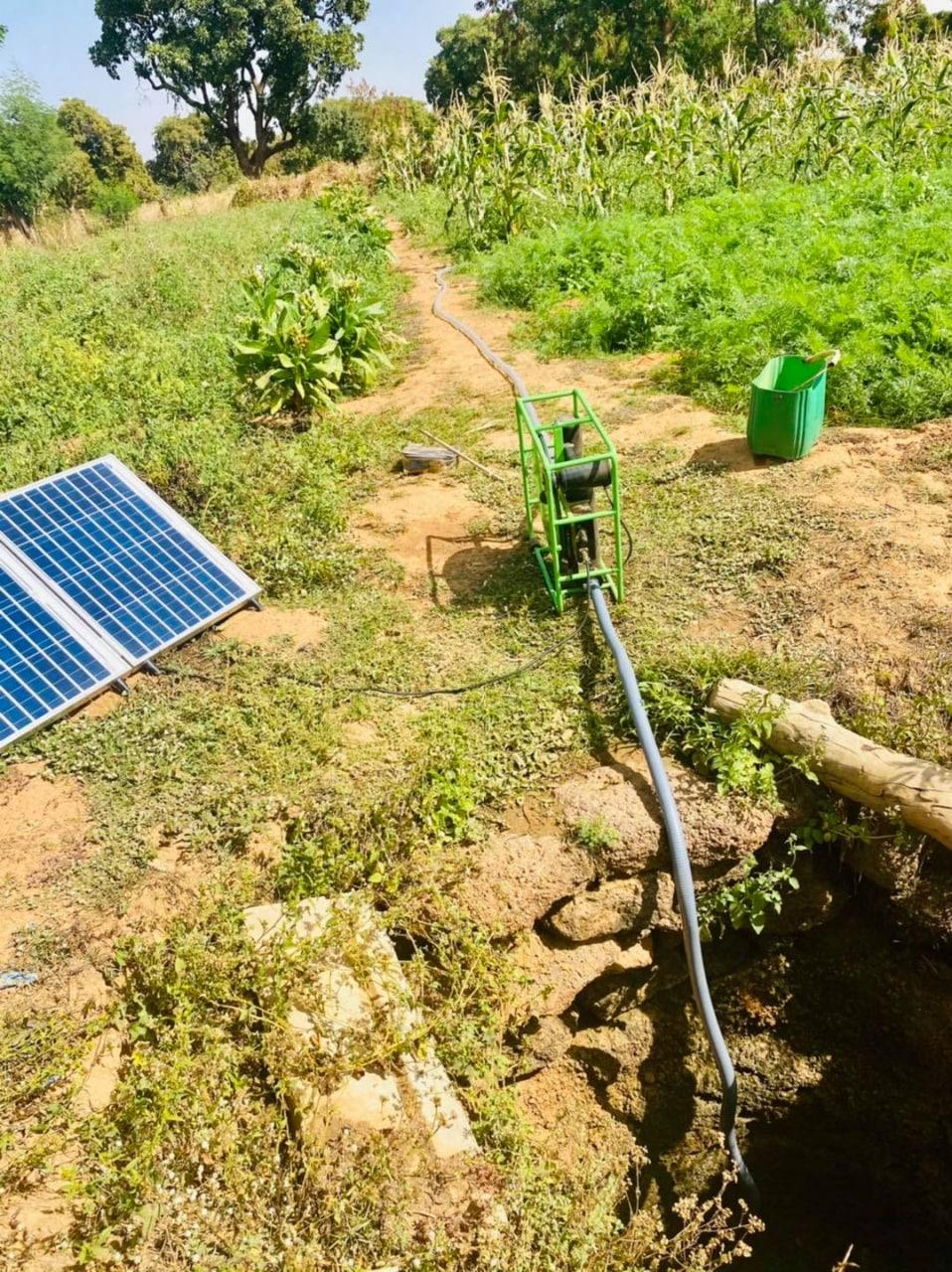
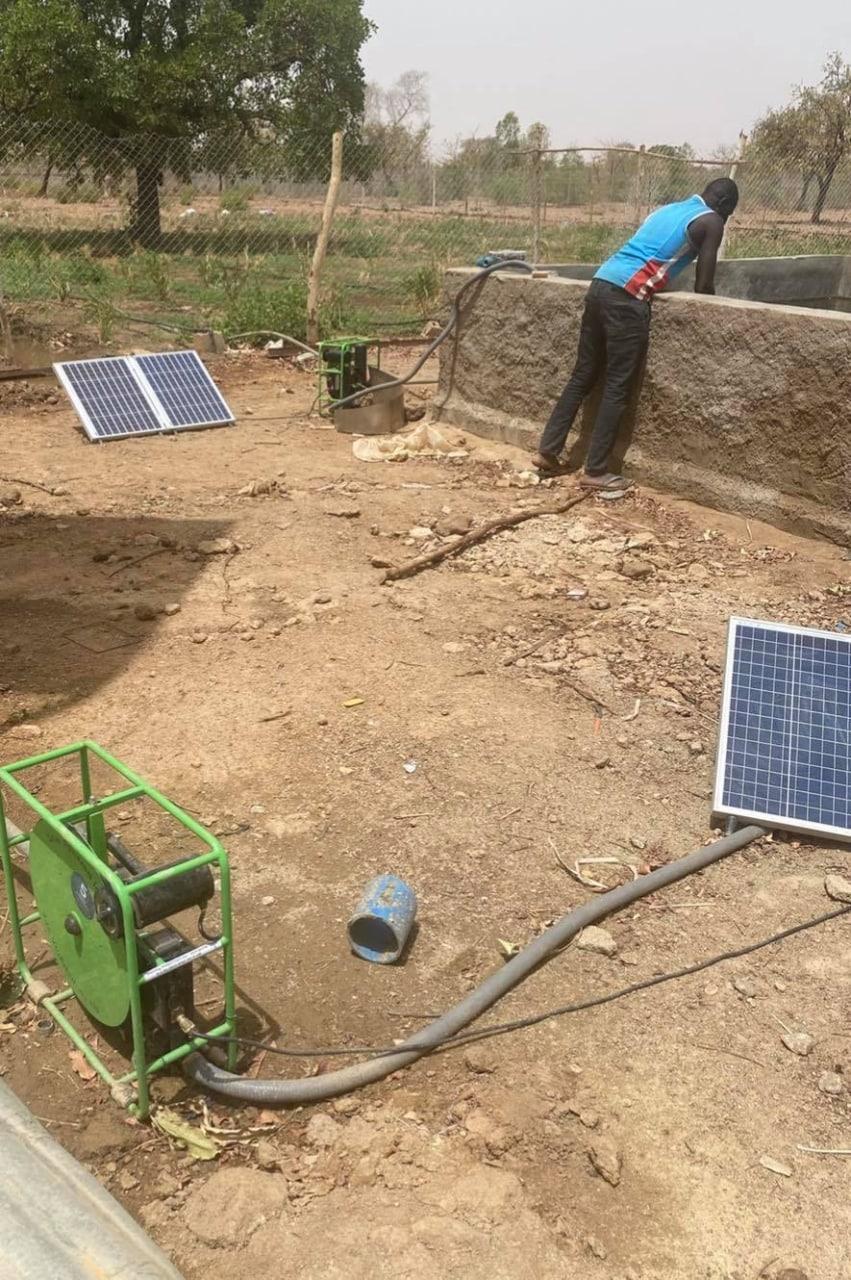
A solar pumping system is usually simpler than people expect. Sunlight hits the panels, the panels produce DC electricity, a controller conditions it, and the pump runs. There is no fuel, no grid connection, and in most water systems no battery at all.
That last part surprises people, so it is worth stating plainly: the usual design does not store electricity, it stores water. The pump runs while the sun is up and fills a tank or cistern; you draw from that tank whenever you need it, on gravity or with a small pressure pump. A tank is cheaper than a battery bank, it does not degrade the way batteries do, and it fails gracefully.
The practical consequence is that output follows the sun. A solar pump does not deliver a constant rate the way a grid pump does — it ramps up through the morning, peaks around the middle of the day and falls off toward evening, and it produces less under heavy cloud. Systems are therefore planned around gallons per day into storage rather than gallons per minute at any given instant.
Deep-well and surface pumps are different tools
The single biggest fork in the conversation is where the water sits relative to the pump.
A surface pump sits above the water and pulls it toward itself. Because it works by suction on the inlet side, there is a physical limit to how far below the pump the water can be before suction stops working at all — a limit set by atmospheric pressure, not by how good the pump is. Surface pumps suit ponds, streams, canals, tanks, shallow hand-dug wells and any source where the water is at or near the pump’s own level. They are easy to reach, easy to service and easy to move.
A deep-well (submersible) pump goes down the borehole and sits in the water, pushing it up rather than sucking it. Pushing has no equivalent hard ceiling, which is why every genuinely deep well uses a submersible. The trade-off is access: the pump is at the bottom of a cased hole, so installation and any future service means pulling it, which is contractor work with the right equipment.
If your water sits well below where the pump itself would sit, you are almost certainly in submersible territory. Where exactly the line falls for your site depends on your numbers, and it is one of the first things a quote should settle.
Deep-well solar pumps → · Surface & trash pumps →
Head and flow, in plain terms
Two numbers describe what you are asking a pump to do. Every pump conversation, every datasheet and every quote comes back to them.
Head
How hard the pump has to push, expressed as a height. It is not just the depth of the well: total head adds the vertical lift from the water level up to the outlet, any further rise to a tank on a hill or a stand, and a further allowance for friction as water drags against the inside of the pipe over distance. Longer or narrower pipe means more friction and therefore more effective head.
Flow
How much water arrives, usually stated in gallons per minute, or in gallons per day once you account for how many usable hours of sun a site gets. Flow is what you actually care about; head is the cost of getting it.
The two trade against each other. For a given pump and a given amount of sunlight, asking for more head gets you less flow, and vice versa. That relationship is published by the manufacturer as a performance curve for each model, and reading your requirement against that curve is exactly what sizing is. It is also why a number quoted with no head attached to it — a bare “this pump does X gallons per minute” — tells you almost nothing.
We have not published curves or performance figures for our own models yet. When we do, they will be the manufacturer’s measured figures, and they will appear in the spec tables on the product pages rather than in prose here.
What to gather before you ask for a quote
You do not need all of this, and rough figures are genuinely fine to start — but the more of it you have, the faster the conversation gets to a real answer instead of a range. Much of it is on your well log or well completion report, if you have one; your county or state groundwater office may hold a copy if you do not.
- Well depthHow deep the borehole itself goes, from ground level to the bottom. This sets the outer bound on where a pump can sit.
- Static water levelHow far down the water sits when nothing has been pumping. This, not the total well depth, is the number most lift calculations start from — and the two are often very different.
- Drawdown or pumping water levelHow far the water level drops while the well is being pumped, and what rate it recovers at. If your well log records a yield or recovery test, that is the figure.
- Water you actually needGallons per day is more useful than gallons per minute for a solar system, since it fills storage over a whole day. Say what it is for — stock tanks, irrigation, general non-potable supply.
- Distance and rise to the tankHow far horizontally the water has to travel from the wellhead, and how much further up it has to climb to reach the tank inlet. Both feed the head figure.
- Casing diameterThe inside diameter of the well casing, which decides whether a given submersible physically fits down it.
- Existing storageWhether you already have a tank or cistern, and roughly how big — storage you already own changes the shape of the whole system.
- The site itselfYour location, whether the wellhead gets unshaded sun through the day, and whether the ground suits a pole or ground mount. Shade on the array is the most common avoidable problem.
If you have a well log or completion report, sending it with your enquiry is the single most useful thing you can do. If you have none of this, say so — we will tell you what is worth measuring first.
Who should size and install it
This page is background reading, not a specification. We are deliberately not publishing rules of thumb that would let you skip the two people who should be involved:
- A licensed well or pump professional for anything to do with the well itself — assessing its yield, selecting and setting a pump, and all the downhole work.
- A licensed electrician for wiring, disconnects, grounding and bonding.
Well construction and electrical work are permitted and inspected by your local authority having jurisdiction, and requirements vary by state and county. Confirm yours before you order anything. We are not an installation company: we supply the equipment, work through the sizing with you, and hand over the manufacturer’s documentation. We do not design to code on your behalf.
Rough numbers are fine to start. Invented ones are not.
Keep reading
Where this equipment comes from.
The pumps described here are the ones our sister company sells and services in Burkina Faso — deep water tables, sustained heat, no grid.
No checkout — we quote by hand
Tell us about your well.
Send whatever numbers you have — depth, static water level, how much water you need per day — and we will tell you what we would put on it, or tell you honestly if we do not have the right product for the job.